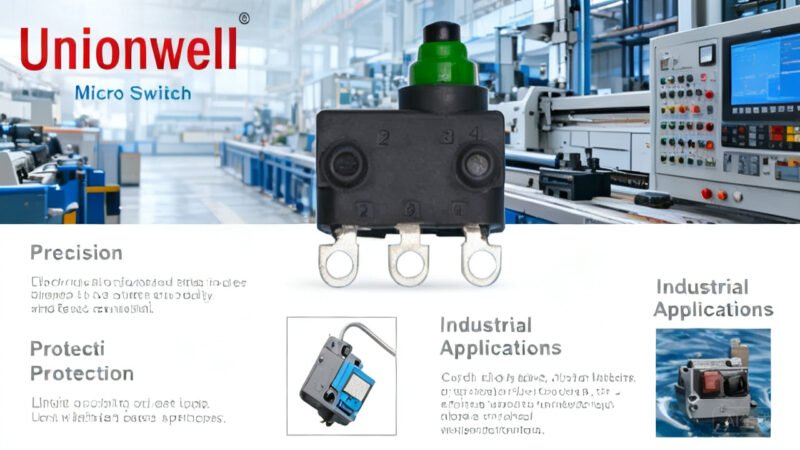
In the intricate world of industrial automation, manufacturing, and consumer electronics, the smallest components often play the most critical roles. Among these, micro switches, limit switches, and their specialized waterproof counterparts stand out as fundamental elements for ensuring precision, safety, and reliability. These unassuming devices are the silent workhorses, detecting positions, controlling sequences, and protecting machinery across countless applications. For businesses seeking robust and dependable control solutions, understanding the nuances and capabilities of these switches, and partnering with a reputable micro switch manufacturer, is paramount.
Understanding the Core: What is a Micro Switch?
At its heart, a micro switch is a small, electromechanical switch known for its snap-action mechanism. This mechanism ensures that the contacts switch rapidly and decisively from one state to another, regardless of how slowly the actuator is pressed. This snap action is crucial for several reasons: it minimizes arcing, prolongs contact life, and provides a crisp, repeatable switching point. Micro switches typically feature a small operating force and a high degree of precision, making them ideal for applications requiring accurate position detection or simple on/off control.
Their versatility stems from a variety of available actuator types, including pin plungers, roller levers, hinge levers, and more, allowing them to be integrated into diverse mechanical systems. From detecting a closed door in an appliance to verifying the position of a component on an assembly line, the micro switch is a ubiquitous component, forming the backbone of many control circuits.
The Robustness of Control: Introducing Limit Switches
A limit switch is essentially a specialized type of micro switch, engineered for more demanding industrial environments. Its primary function is to detect the presence or absence of an object, or to monitor the limits of its movement. Unlike standard micro switches often found inside finished products, limit switches are typically more robust, encased in durable housings designed to withstand mechanical stress, vibration, and environmental factors. They are the eyes and ears of industrial machinery, signaling when a machine part has reached its maximum or minimum travel point, or when a safety gate is open or closed.
Common applications for limit switches include controlling the movement of conveyors, ensuring the proper positioning of robotic arms, acting as safety interlocks on machine guards, and detecting the end-of-travel for actuators and cylinders. Their heavy-duty construction, often featuring metal housings and sealed designs, makes them indispensable in factories, processing plants, and heavy equipment where reliability under harsh conditions is non-negotiable.
Conquering Harsh Environments: The Imperative of Waterproof Micro Switches
While standard micro and limit switches excel in many settings, certain environments demand an even higher degree of protection. This is where waterproof micro switches become indispensable. Designed to operate flawlessly in the presence of water, dust, oil, and other contaminants, these switches are engineered with superior sealing technologies, often achieving IP (Ingress Protection) ratings like IP67 or IP68. An IP67 rating, for instance, signifies complete protection against dust ingress and the ability to withstand temporary immersion in water up to 1 meter for 30 minutes.
The need for waterproof micro switches spans a vast array of industries:
- Automotive: For detecting door closure, hood latches, or gear positions where exposure to moisture is common.
- Marine: In boat controls, navigation equipment, and deck machinery.
- Food & Beverage: For equipment requiring frequent washdowns to maintain hygiene standards.
- Outdoor Equipment: In construction machinery, agricultural vehicles, and public utility systems exposed to weather.
- Medical Devices: Where sterilization and liquid resistance are critical.
These switches typically employ specialized sealing materials, epoxy potting, and precision-fitted components to prevent ingress, ensuring consistent performance and longevity even in the most challenging conditions. Opting for a waterproof micro switch from a reputable manufacturer ensures that critical systems remain operational, minimizing downtime and maintenance costs.
Key Considerations When Choosing a micro switch manufacturer
Selecting the right partner for micro, limit, and waterproof switches is crucial for the performance and longevity of your products and systems. Here are critical factors to consider:
- Quality and Reliability: Look for manufacturers with a proven track record of producing high-quality components that meet or exceed industry standards. This includes robust materials, precise manufacturing processes, and rigorous testing protocols.
- Precision and Repeatability: The accuracy of the switching point and its consistency over millions of cycles are paramount, especially in automation and safety-critical applications.
- Environmental Durability: For limit and waterproof switches, assess their IP ratings, operating temperature range, and resistance to vibration, shock, and corrosion.
- Variety and Customization: A good manufacturer offers a wide range of actuators, terminal types, electrical ratings, and mounting options. The ability to customize switches for specific application requirements is a significant advantage.
- Certifications: Ensure switches comply with relevant international standards such as UL, CE, CQC, and RoHS, indicating adherence to safety and environmental regulations.
- Technical Support and R&D: A manufacturer committed to innovation and providing excellent technical support can be an invaluable partner in design and problem-solving.
- Supply Chain Stability: Reliable delivery and consistent product availability are essential for maintaining production schedules.
Conclusion: The Unseen Heroes of Control
Micro switches, limit switches, and waterproof micro switches may be small, but their impact on industrial efficiency, safety, and reliability is immense. They are the unseen heroes ensuring that complex machinery operates smoothly, processes run precisely, and systems remain safe, even in the harshest environments. For any business involved in manufacturing, automation, or product development, partnering with an experienced and quality-focused micro switch manufacturer is not just a choice, but a strategic imperative to build resilient, high-performing systems that stand the test of time and environment.