In the intricate world of industrial automation and control systems, the reliability and precision of every component are paramount. Among the most fundamental yet critical elements are micro switches and limit switches, serving as the sensory organs of countless machines and processes. Their unassuming size often belies their immense importance in ensuring operational efficiency, safety, and longevity across diverse sectors. For any B2B professional involved in design, procurement, or maintenance, understanding the nuances of these essential components, including specialized variants like waterproof micro switches, is crucial for optimizing system performance and achieving a competitive advantage.
At the heart of many automated systems lies the micro switch, a small, sensitive snap-action switch designed to rapidly change the state of an electrical circuit with minimal movement. Characterized by their precise actuation point and excellent repeatability, micro switches are engineered for applications requiring high accuracy and a long mechanical life. Their internal mechanism typically involves a tiny spring-loaded lever system that, when actuated, quickly snaps the contacts open or closed, ensuring a clean break or make regardless of the speed of the actuator. This “snap-action” principle is vital; it prevents slow contact closure or opening, which can lead to arcing, contact bounce, and premature wear, thus extending the contact life and ensuring reliable switching even under high-frequency operation.
Key Characteristics and Advantages:
- High Precision and Repeatability: Consistent actuation points ensure reliable operation over millions of cycles, critical for precision machinery.
- Rapid Switching Speed: Minimizes contact bounce and wear, enhancing electrical performance and durability.
- Compact Size: Enables integration into space-constrained designs, facilitating miniaturization in various products.
- Long Mechanical Life: Capable of millions of cycles, ensuring long-term durability and reduced maintenance.
- Versatile Actuators: Available with various levers, plungers, and rollers to suit different mechanical interfaces and operating forces.
Common Applications:
Micro switches are ubiquitous across industries. They are found in household appliances (e.g., washing machines, microwaves, refrigerators) for door interlocks and cycle control, automotive systems (e.g., door locks, seat belt sensors, gear shifters, power window controls), and industrial machinery (e.g., safety interlocks, control panels, pressure switches, flow switches). Their ability to detect minute movements makes them indispensable for position sensing, end-of-travel detection, and critical safety cut-offs, ensuring both operational efficiency and user safety.
Limit Switches: Robust Sentinels of Position
While sharing some functional similarities with micro switches, limit switches are generally more robust and designed for tougher industrial environments. A limit switch is an electromechanical device that detects the presence or absence of an object, or verifies the position of a moving part, by making or breaking electrical contact. They are fundamental to machine control, providing critical feedback to PLCs (Programmable Logic Controllers) and other control systems, often controlling the limits of motion for machinery.
Key Differences and Applications:
Unlike many standard micro switches, limit switches often come in larger, more rugged enclosures designed to withstand dust, moisture, oil, and significant mechanical shock and vibration. They typically feature heavier-duty contacts and can handle higher electrical loads, making them suitable for directly switching motor starter coils or solenoid valves. Their actuators are also more varied and robust, including roller levers, plunger types, rotary heads, and cat whisker designs, allowing for diverse mechanical interactions. Common applications include conveyor systems for material handling, machine tools for detecting workpiece position, safety gates on industrial machinery, and overhead cranes for preventing over-travel. Their ability to operate reliably in harsh conditions and provide precise positional feedback makes them indispensable in heavy manufacturing, automotive assembly lines, and packaging industries.
The Imperative of Waterproof Micro Switches
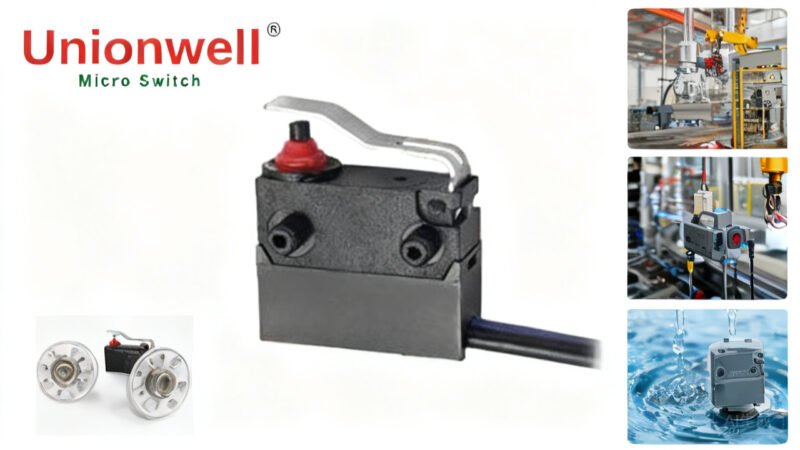
In environments where exposure to liquids, dust, or corrosive agents is a constant threat, standard switches simply won’t suffice. This is where waterproof micro switches become critical. Engineered with enhanced sealing mechanisms, these specialized switches provide reliable operation even when submerged or subjected to high-pressure washdowns. The term “waterproof” often translates to specific IP (Ingress Protection) ratings, such as IP67, indicating complete protection against dust ingress (first digit ‘6’) and protection against immersion in water up to 1 meter for 30 minutes (second digit ‘7’). Higher ratings like IP68 are also available for continuous submersion.
Why Waterproofing Matters:
- Extended Lifespan: Protection from environmental contaminants significantly prolongs the switch’s operational life, reducing replacement costs and downtime.
- Enhanced Safety: Prevents electrical shorts and malfunctions in wet conditions, crucial for operator safety and equipment integrity, especially in hazardous locations.
- Reliable Performance: Ensures consistent operation in challenging conditions, maintaining productivity and process control without interruptions.
- Compliance: Meets stringent industry standards for hygiene and safety in sectors like food processing, pharmaceutical, and marine, where regular cleaning is mandatory.
Applications Demanding Waterproof Solutions:
Waterproof micro switches are essential in outdoor equipment (e.g., agricultural machinery, construction vehicles, lawnmowers), marine applications (e.g., boat controls, navigation systems, bilge pumps), food and beverage processing equipment (where regular washdowns are mandatory to maintain hygiene), medical devices that require sterilization, and automotive applications exposed to weather, engine fluids, and road spray. Their robust design, often featuring epoxy potting, O-rings, and specialized gaskets, ensures that critical controls remain functional regardless of environmental adversity, minimizing costly failures and maximizing operational continuity.
Selecting the Right Switch: A Manufacturer’s Perspective
Choosing the optimal micro switch or limit switch for a specific application requires careful consideration of several factors. A reputable micro switch manufacturer plays a pivotal role in guiding this decision-making process, offering not just products but also invaluable expertise and support.
Key Selection Criteria:
- Environmental Conditions: Assess the operating temperature range, humidity, presence of dust, water, oil, or corrosive chemicals. This dictates the need for sealed or waterproof variants and specific housing materials (e.g., stainless steel, reinforced plastic). Also consider vibration and shock resistance.
- Electrical Requirements: Match the switch’s voltage and current ratings (AC/DC) to the circuit’s demands to prevent premature failure. Consider the type of load (resistive, inductive, lamp) as this affects contact wear.
- Operating Force and Travel: Determine the precise force required to actuate the switch and the necessary travel distance for reliable operation. This impacts user experience and mechanical integration.
- Actuator Type: Select from various actuators (pin plunger, lever, roller lever, push button, rotary) based on the mechanical interface with the target object, ensuring smooth and consistent actuation.
- Mounting Options: Consider mounting hole patterns, dimensions, and ease of installation (e.g., panel mount, PCB mount, chassis mount) to fit seamlessly into the product design.
- Material Durability: Evaluate contact materials (e.g., silver alloy for general use, gold plating for low current and high reliability) and housing materials for robustness, chemical resistance, and longevity.
- Certifications: Ensure compliance with relevant industry standards such as UL, CE, RoHS, ENEC, and others specific to your region or application, guaranteeing safety and market acceptance.
The Value of a Quality Manufacturer:
Partnering with an experienced micro switch manufacturer is paramount. A leading manufacturer invests significantly in research and development, offering a wide range of standard and customizable solutions. They provide comprehensive technical specifications, reliable supply chains, and expert technical support to help engineers integrate the right switch seamlessly into their designs. This commitment to quality, backed by rigorous testing and adherence to global manufacturing standards, translates directly into enhanced product reliability, reduced design cycles, and ultimately, a more competitive end product for B2B clients. Their ability to offer customized solutions for unique application challenges can be a significant advantage, ensuring optimal performance and longevity.
Conclusion
Micro switches, limit switches, and their waterproof counterparts are more than just simple electrical components; they are critical enablers of precision, safety, and efficiency in modern industrial and commercial applications. Their careful selection, guided by a deep understanding of application requirements and the support of a trusted manufacturer, is fundamental to the success and longevity of any automated system. By prioritizing quality, durability, and suitability for the operating environment, businesses can ensure their systems perform optimally, minimize downtime, enhance safety, and maintain a leading edge in a rapidly evolving technological landscape. Investing in the right switch is an investment in the reliability and future performance of your entire system.