Micro switches, often unassuming in their size, are indispensable components in countless industrial and commercial applications. These precision-engineered devices play a critical role in controlling electrical circuits, providing feedback, and ensuring safety across a vast array of machinery and systems. From intricate medical equipment to heavy-duty industrial automation, the reliability and accuracy of a micro switch can directly impact operational efficiency, safety protocols, and overall system longevity. For businesses and engineers, understanding the nuances of micro switch selection is paramount to achieving optimal performance and avoiding costly failures. This guide delves into the essential considerations for choosing the right micro switch, highlighting key types and the importance of partnering with a reputable micro switch manufacturer.
At its heart, a micro switch is a small, sensitive snap-action switch that requires minimal force to operate. Its defining characteristic is the rapid, definitive transfer of contacts from one position to another, regardless of the speed of the actuator. This “snap-action” mechanism ensures a quick make-and-break, minimizing arcing and extending the switch’s electrical life. Typically featuring a common terminal, a normally open (NO) terminal, and a normally closed (NC) terminal, micro switches offer versatile control options, making them fundamental for sensing position, detecting presence, and providing interlock functions in diverse environments.
Key Selection Criteria for Industrial Micro Switches
Choosing the correct micro switch involves a careful evaluation of several critical factors to ensure compatibility, reliability, and longevity in its intended application.
Actuator Type
The actuator is the part of the switch that receives the external force. Common types include pin plungers for direct actuation, various lever types (straight, roller, simulated roller) for applications requiring mechanical advantage or sensing moving parts, and push buttons. The choice depends on the mechanism providing the actuating force and the required overtravel.
Electrical Ratings
This is perhaps the most crucial specification. It includes the maximum voltage (AC/DC) and current the switch can safely handle. It’s vital to consider both resistive and inductive loads, as inductive loads (like motors or solenoids) produce voltage spikes that can degrade contacts over time. Underrated switches lead to premature failure, while overrated switches can be an unnecessary expense.
Operating Force and Overtravel
The operating force specifies the minimum force required to actuate the switch. Overtravel is the distance the actuator can continue to move past the operating point without damaging the switch. These parameters are critical for precise sensing applications and for ensuring the switch integrates correctly with mechanical systems.
Contact Configuration
Most micro switches are Single Pole Double Throw (SPDT), offering both Normally Open (NO) and Normally Closed (NC) contacts. Other configurations like SPST-NO or SPST-NC are also available, providing flexibility for different control circuit designs.
Environmental Considerations
The operating environment heavily influences switch selection. Factors like temperature range, humidity, dust, and exposure to liquids or corrosive substances dictate the need for specialized designs. Standard switches might suffice for controlled indoor environments, but harsher conditions demand more robust solutions.
Mechanical and Electrical Life
These specifications denote the number of operations a switch can perform before mechanical failure or before its electrical contacts degrade beyond acceptable limits. For high-cycle applications, selecting switches with high mechanical and electrical life ratings is essential to minimize maintenance and downtime.
Specialized Micro Switch Applications
While standard micro switches serve a broad spectrum of uses, specific industrial demands often call for specialized variants.
Limit Switches
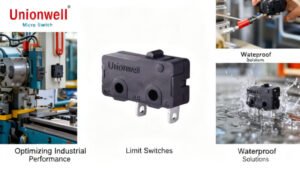
Limit switches are a robust category of micro switches designed for industrial environments to detect the presence or absence of an object, or to monitor the limits of travel for moving machinery. They are fundamental in automation for position sensing, safety interlocks, and controlling machine sequences. Typically housed in durable, often metal, enclosures, limit switches are built to withstand significant mechanical stress, vibration, and environmental exposure, making them indispensable in manufacturing, robotics, and material handling.
Waterproof Micro Switches
For applications exposed to liquids, dust, or harsh weather conditions, waterproof micro switches are non-negotiable. These switches feature sealed enclosures, often with an Ingress Protection (IP) rating like IP67 or IP68, indicating their ability to resist dust ingress and immersion in water. Common applications include outdoor equipment, marine electronics, automotive systems, and food processing machinery where washdowns are frequent. The sealing method, whether through epoxy encapsulation or specialized gaskets, ensures reliable operation even in challenging wet or dusty environments.
The Advantage of Partnering with a Leading micro switch manufacturer
The performance and longevity of your micro switches are directly tied to the quality of their manufacturing. Partnering with a reputable micro switch manufacturer offers significant advantages. Such manufacturers adhere to stringent quality control standards, employ advanced testing methodologies, and often hold international certifications (e.g., UL, CE, CQC) that guarantee product reliability and safety. They also typically offer a wide range of standard products, alongside customization options to meet unique application requirements.
Manufacturers like unionwell, for instance, are known for their commitment to precision engineering, offering a diverse portfolio of micro switches, limit switches, and waterproof micro switches designed to meet demanding industrial specifications. Their expertise ensures that components not only perform as expected but also contribute to the overall efficiency and safety of complex systems.
Diverse Applications Across Industries
Micro switches are the silent workhorses in sectors ranging from automotive (door latches, seat belt sensors) and consumer appliances (microwave ovens, washing machines) to medical devices, HVAC systems, and heavy industrial machinery, underscoring their versatility and critical importance in modern technology.
Conclusion
The seemingly simple click of a micro switch belies its profound impact on industrial functionality and safety. Careful consideration of actuator type, electrical ratings, environmental factors, and durability is essential for selecting the optimal component. Whether it’s the robust detection capabilities of a limit switch or the sealed reliability of a waterproof micro switch, choosing the right product from a trusted micro switch manufacturer is paramount. By prioritizing quality and precision in component selection, businesses can ensure the long-term reliability, efficiency, and safety of their critical systems, thereby optimizing operational performance and safeguarding investments.